Archive for April, 2010

450px Kiel Church and the Morvern Cross%252C Lochaline What Does the Word, Atonement, Mean?

The Sacrifice for Sin

For God presented Jesus as the sacrifice for sin. People are made right with God when they believe that Jesus sacrificed his life, shedding his blood. This sacrifice shows that God was being fair when he held back and did not punish those who sinned in times past . . . .

Rom. 3:25 NLT

Last week, a young man in my parish, asked what the word, “atonement,” meant. His request made me go back and rethink my answer. In summary, atonement is the work that Christ did in his life, death, burial, resurrection, and ascension, which provided the way for us to come back to God in right relationship.

J. I. Packer writes “Atonement means making amends, blotting out the offense, and giving satisfaction for wrong done; thus reconciling to oneself the alienated other and restoring the disrupted relationship” (Concise Theology: A Guide to Historic Christian Belief). I have heard several preachers reflect that atonement means “at-one-ment,” Jesus’s sacrifice has given us the opportunity to be in “oneness” with our heavenly Father.

God displays his righteousness by judging sin as sin deserves, but the judgment is diverted from the guilty and put on to the shoulders of Jesus Christ, the sinless Son of God acting as wrath absorber. The atonement had to be costly because it was necessary in light of the nature of God, which must inflict retributive punishment on sin. A marvelous wisdom of God consists in his establishing the Lord Jesus as our representative and our substitute because only he could bear and absorb the judgment due to us. Being our representative makes him our substitute, and so he suffers and we go free . . . .

J. I. Packer, “The Necessity of the Atonement” in Atonement, ed. Gabriel N. E. Fluhrer (Phillipsburg, NJ: P & R Publishing, 2010), 15-16.

HT: Of First Importance

holy communion 241x300 Anamnesis: Christ Is Present

Christ is Present

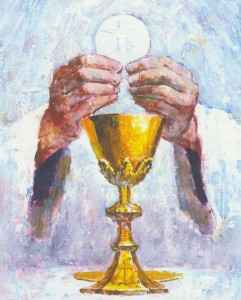
And he took bread, gave thanks and broke it, and gave it to them, saying, “This is my body given for you; do this in remembrance of me” (Luke 22:19 NIV).

Remembrance is the Greek word, anamnesis. Anamnesis does not mean memory by mental recall, but the fresh experience of a past event by reenactment. This mysterious work of the Holy Spirit brings the evening of the Last Supper forward in order that the people of God may experience the crucified and resurrected Christ afresh. At the Last Supper, the apostles realized all the benefits of the Cross before Christ actually died. In the same way, when we partake of the Body and Blood of Christ, we encounter afresh all benefits of Christ work on the cross: freedom, forgiveness, life-transformation, etc.  These benefits are imparted to us at the moment we partake of the Body and Blood of Christ (Luke 22:19; 1 Cor. 11:23-26).

I believe music-centered worship has indeed become a common way of thinking about the presence of God. However, it is an extremely limited understanding of God’s presence. . . . The church has always believed not only that God is everywhere but also that he is made intensely present to his church at worship. God is there in the gathering of the assembly, in song, in Scripture reading, in prayer, and especially at bread and wine. Jesus told his disciples that there is a way to remember him (the force of anamnesis is “to make me [Christ] present”). He is right there at broken bread and poured-out wine.

Robert E. Webber, Ancient-Future Worship: Proclaiming and Enacting God’s Narrative. (Grand Rapids: Baker Books, 2008), 133-134.

HT: Webber Quote of the Week


mark15a Good Friday Is Not a Funeral

The Cross Is the Victory

And you, who were dead in your trespasses and the uncircumcision of your flesh, God made alive together with him, having forgiven us all our trespasses, by canceling the record of debt that stood against us with its legal demands. This he set aside, nailing it to the cross. He disarmed the rulers and authorities and put them to open shame, by triumphing over them in him.

Col. 2:13-15

Many misunderstand, they see the Cross as a defeat. They see Christ’s weakness, suffering, and humiliation as failure to convince the crowds, persuade the Jewish leaders, and empower the disciples. Some grand misunderstanding created this tragedy. However in the minds of these people, God vindicated Jesus by raising him from the dead. God the Father by power of the resurrection snatched victory from jaws of the Cross’ defeat.

Nothing is further from the truth. The Cross is the victory of God and the resurrection is the announcement to the world that the Christ has triumphed over all our foes. The Cross was not a defeat, but the astonishing victory of God over the world, the flesh, sin, death, and the devil.

A number of metaphors are used in scripture to describe the finished work of Christ on the Cross: victory over the oppression and enslavement of sin (1 Cor. 15:57), justification that satisfies the penalty of sin (Rom. 4:25), adoption which grants me the legal status of a son of God and an heir of the kingdom (Rom. 8:17, 23), reconciliation which restores my broken relationship with God (2 Cor. 5:19), forgiveness of our offenses as a result of his pain and suffering on Calvary, redemption  and ransom paid to free me from the captivity of sin(1 Cor. 6:19), healing from brokenness created by my sin (Isa.53:5), representative bringing us all the privileges of the new covenant (Rom. 5:17), participation in all the benefits of his death, burial, and resurrection (Rom. 6), and substitution for he took upon himself our punishment, guilt, and shame (Rom. 4:25).

The Cross accomplished all these things and more.

The whole story in the New Testament is written, as I have said, from the point of view of the Resurrection, and the Christian faith is inexplicable otherwise. Another point to be made is that the story of the Resurrection is not told in the New Testament as the story of a victory which wipes out the defeat of the Cross.

On the contrary, there is great emphasis laid on the fact that the risen Lord is the crucified one. It is said that when, he showed himself to his disciples, he showed them his hands and his side. In other words he identified himself deliberately to them as the one who had been crucified. And according to the records that we have, in his teaching of them, he emphasised the fact that it was necessary for the Messiah to suffer in this way.

Above all in Paul, whose life as a Christian began with a meeting with the risen Lord, it is nevertheless the Cross which is the centre of his message. The Cross, in other words, is not put before us a defeat overruled by God; on the contrary, the Cross is put before us as a victory which was acknowledged and ratified by God.

Bishop Lesslie Newbigin, Journey Into Joy (Grand Rapids, MI: Eerdmans, 1972), 45.