Archive for August, 2011

Heart Change Wrought by the Holy Spirit

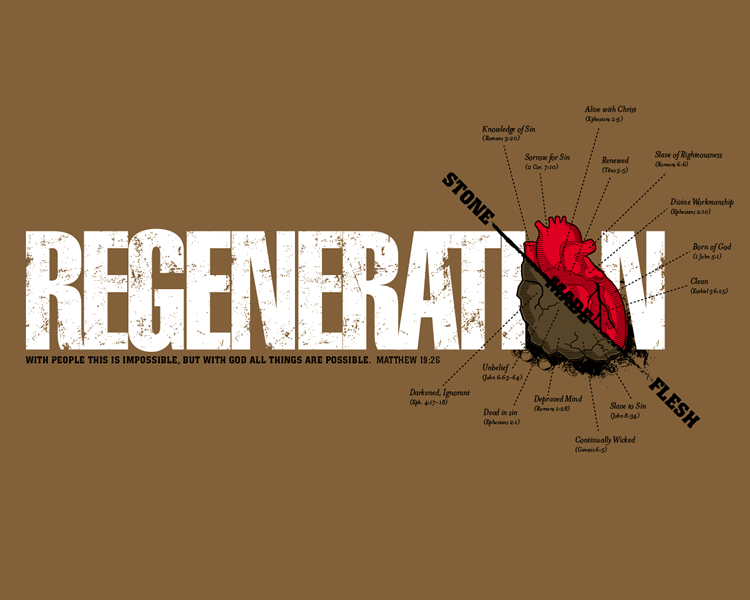
And I will give you a new heart, and a new spirit I will put within you. And I will remove the heart of stone from your flesh and give you a heart of flesh.

Ezekiel 36:26

He saved us, not because of works done by us in righteousness, but according to his own mercy, by the washing of regeneration and renewal of the Holy Spirit, [6] whom he poured out on us richly through Jesus Christ our Savior,

Titus 3:5-6

Regeneration is a change wrought by the Holy Spirit in the heart of a person transforming their motivation from a heart of self-centeredness to a will that is Christ-loving and people-serving. This work of regeneration is released by faith and changes us from hearts of stone, that can only sin, and nothing else, to hearts that serve, love, and sacrifice.

This means that our regeneration is owing to the historical work of Christ. . . . New birth is not a vague spiritual change disconnected from history. It is an objective historical act of the Spirit of God connecting us by faith to the historical, incarnate—the appearing—Lord Jesus, so that the life he now has as the crucified and risen Savior has become our life because we are united to him. New birth happens because Jesus came into the world as the kindness and love of God and died for sins and rose again.

John Piper, Finally Alive: What Happens When We Are Born Again (Christian Focus, 2009), 94.


Apostolic Authority and Character  

It has seemed good to us, having come to one accord, to choose men and send them to you with our beloved Barnabas and Paul, . . .

Acts 15:25 ESV

Apostolic Succession is historic continuity with the apostles imparted through the laying on of hands in ordination; thereby, receiving the apostles’ authority while simultaneously experiencing the Holy Spirit’s anointing to embody apostolic character and teach apostolic doctrine. This ancient succession grants to the bishops the same authority, commission, and responsibility as the apostles. Also, this ancient continuity extends special grace and authority to the clergy from the Holy Spirit to advance the gospel throughout the world. An Anglican theologian defines the doctrine of apostolic succession:

As our blessed Lord ordained the twelve to be his representatives when He left the earth, so the apostles chose others to take their place when they in turn were withdrawn by death. … During this long period, successors of the apostles, first receiving, and then in turn handing on the divine power and authority which Christ gave to the twelve, have never been wanting. The apostolic succession is the link or bond that connects the Church of the 20th century with that of the 1st century.

Vernon Staley, The Catholic Religion (Harrisburg, PA: Morehouse Press, 1983), 15.

The doctrine of apostolic succession has both Petrine and Pauline qualities. Petrine in that the bishop’s consecration and ministry must be in historic continuity with the church catholic and Pauline in that the bishop should be governed by the Holy Spirit and has an individual (not individualistic) walk with the Lord exemplified by the “faith that works through love” (Gal. 5:6).

If a bishop is not Pauline then he is not apostolic. In other words, no matter the fact of his ordination, he is not a representative of the church if he is not living a holy life and does not believe the historic doctrines of the apostles. However, when a bishop is Pauline and not Petrine, he lacks authority in his ministry. That deficiency keeps him from speaking from and to the church. As one presbyter stated:

When I received Christ, I discovered the grace of God. When I received the Baptism of the Holy Spirit, I discovered the power of God. When I received the laying on of hands in apostolic succession of the government of God, I discovered the authority of God.”

Ed Wills, “Sensitive to the Holy Spirit,” Sursum Corda (November 1994), 2.

The Blessing of Abraham

That the blessing of Abraham might come on the Gentiles through Jesus Christ; that we might receive the promise of the Spirit through faith.

Gal 3:14 ESV

The filling of the Holy Spirit is a state of being totally overwhelmed in the presence of Jesus Christ both within and without. To be “filled” for the believer means that he or she is under the controlling influence of the Spirit: the believer is motivated, encouraged, and directed by God.

“Being filled with the Spirit” (Eph. 5:18) refers to God’s presence fully saturating the believer’s heart, soul, mind, and spirit. A “filled” Christian walks in union and communion with God. An individual who is filled with the Spirit is dominated in their person by the Spirit’s presence being a description how they live and love (Luke 4:1; Acts 6:3-5, 7:55, 11:24). The filling of the Spirit is to be a life lived in God’s presence.

The infilling of the Holy Spirit is not confined to a one time experience at conversion or just a singular dramatic encounter occurring later in the Christian life. The infilling of the Spirit is a crisis, a one-time encounter, and a process, an on-going experience: sometimes described as one baptism and many fillings.

The filling of the Spirit should be a moment by moment experience of the constant, conscious presence of Christ.  “Being constantly filled,” with the Holy Spirit is freedom to enjoy Christ and his presence on a daily, if not, hourly, and even possibly, minute-by minute basis. The filling of the Spirit is described by the Apostle Paul as a daily “walking in the Spirit” or a “keeping in step with the Spirit” (Gal. 5:25). The Lord desires something better for us; a continual abiding in the Spirit of Christ (Rom. 8:9) as we perform the daily tasks of life. The Filling of the Holy Spirit is synonymous with the phrase, “baptism of the Holy Spirit.”

The promise of the Spirit is not for great or exceptional Christians, but for any Christian who yields himself to God. Paul addressed everyday Christian believers at Ephesus: husband, wife, parent, child, master, slave. He encouraged all to live lives full of the divine Holy Spirit, full from within.

What this command to be filled with the Spirit meant in Ephesus, it means in England, it means to the one who is writing these words in his study at Cambridge, and to his brother in Christ who reads them, wherever and whenever God has bid him dwell.

H. C. G. Moule quoted in His Victorious Indwelling, ed., Nick Harrison (Grand Rapids, MI: Zondervan, 1998), 158.

Do All to the Glory of God 

So, whether you eat or drink, or whatever you do, do all to the glory of God.

1 Cor. 10: 31 ESV

“Glorify,” means to clothe God in splendor by those who recognize their victory in the Cross, their triumph in the resurrection, and their restoration in the ascension. To glorify is to give the reverence, awe and honor in worship to God for his excellencies and praiseworthiness. We glorify God when we find the Lord beautiful for what he is in himself.

In the difficulties of life, the righteous choices we make and the Christ-like attitude that we maintain gives praise to the holy God we serve. This manifested presence is the person and work of the Holy Spirit magnifying Jesus. To glorify God is to recognize God’s presence in our lives while yielding to his Lordship in utter dependence on his grace.

The chief end of man is to glorify God. And it is truer in suffering than anywhere else that God is most glorified in us when we are most satisfied in Him.

John Piper, Desiring God: Meditations of Christian Hedonist (Sisters, OR: Multnomah, 2003), 288.


A Life That Is Bible Saturated

All Scripture is breathed out by God and profitable for teaching, for reproof, for correction, and for training in righteousness,that ethe man of God2 may be complete, equipped for every good work.

2 Tim. 3:16-17 ESV

The Bible is the Word of God by its immeasurable majesty, moral purity, essential unity, and time-tested faithfulness. The Bible is unique in its power to convince and convert our hearts, comfort and build-up our spirits, and divide and measure our motives. The Bible is encouragement in trial, insight into the tribulations of life, and guidance in the midst of confusion. The Bible is the only book whose author can personally and directly apply its truths to our daily lives. The Bible is to be believed, obeyed, trusted, digested, and honored. When we read the Bible, the Spirit leads us to repent that we may be made holy; hear God’s voice that we may be drawn nearer to Christ, renounce the world that we may be transformed into the image of Christ, revived as the people of God that we may be a light unto the world, and prepared for the Second Coming of Christ that we may be ready to see Christ face-to-face.

Oh, that you and I might get into the very heart of the Word of God, and get that Word into ourselves! As I have seen the silkworm eat into the leaf, and consume it, so ought we to do with the Word of the Lord—not crawl over its surface, but eat right into it till we have taken it into our inmost parts. It is idle merely to let the eye glance over the words, or to recollect the poetical expressions, or the historic facts; but it is blessed to eat into the very soul of the Bible until, at last, you come to talk in Scriptural language, and your very style is fashioned upon Scripture models, and, what is better still, your spirit is flavored with the words of the Lord.

I would quote John Bunyan as an instance of what I mean. Read anything of his, and you will see that it is almost like the reading the Bible itself. He had read it till his very soul was saturated with Scripture; and, though his writings are charmingly full of poetry, yet he cannot give us his Pilgrim’s Progress—that sweetest of all prose poems — without continually making us feel and say, “Why, this man is a living Bible!” Prick him anywhere—his blood is Bibline, the very essence of the Bible flows from him. He cannot speak without quoting a text, for his very soul is full of the Word of God. I commend his example to you, beloved.

”Mr. Spurgeon as a Literary Man,” in The Autobiography of Charles H. Spurgeon, Compiled from His Letters, Diaries, and Records by His Wife and Private Secretary, vol. 4, 1878-1892 (Curtis & Jennings, 1900), p. 268.

Liberation from Tyranny or Restraint 

For freedom Christ has set us free; stand firm therefore, and do not submit again to a yoke of slavery.

Galatians 5:1 ESV

Freedom is the ability to do what we want to do. What a Christ-follower wants to do is please their Lord and Savior. Christian freedom is not the freedom to do whatever I want, but the freedom to do what is right by God. Freedom for the Christian is the heart-felt, passionate desire to please their Lord.

By contrast, legalism, that is the law, can only motivate through fear of rejection, punishment, and slavish duty. Legalists are fear-based, proud, and guilt-ridden which leads to touchiness, insecurity, pride, discouragement, and weariness. The legalist believes that they are not valuable to the kingdom of God unless they perform well. They cannot receive Christ’s righteousness for they feel that they are unworthy creatures who have not done enough. Rule keeping is a perversion of freedom: we think by doing we can achieve acceptance by God. Legalism stifles joy and freedom in the Christian life.

On the contrary, the saint is free for he or she is liberated by their righteous standing in Christ: nothing they do or fail to do will change their status as saints in Christ. God’s grace magnifies God’s unconditional love and motivates us by filling our hearts with overwhelming gratitude and appreciative love.

True freedom is not freedom from all responsibility to God and man in order to live for myself, but the exact opposite.  True freedom is freedom from myself and from the cramping tyranny of my own self-centeredness, in order to live in love for God and others.  Only in such self-giving love is an authentically free and human existence to be found.

John Stott, ‘Obeying Christ in a Changing World’, in Obeying Christ in a Changing World, Vol. 1: The Lord Christ (London: Collins, 1977), 28.

 Passionate Love

Then Mary took a twelve-ounce jar of expensive perfume made from essence of nard, and she anointed Jesus’ feet with it, wiping his feet with her hair. The house was filled with the fragrance.

John 12:3

Christian devotion is the spontaneous act of extravagant love which ignores all social conventions and practical logic in order to pour out on Jesus all adoration, praise, and honor.

In our attitude, extravagant love is unreserved: no cultural norms or personal inhibitions will stop us from adoring our Lord. Extravagant love is unashamed: no fear of embarrassment will prevent us from displaying our love for Christ. Extravagant love is unexpected: we love Christ passionately because he loved us graciously. Extravagant love is unrehearsed: our gratitude to him flows spontaneously out of thankful hearts. Extravagant love is unreal: our love is a supernatural work of the Holy Spirit.

In our actions, extravagant love is a passionate burning heart on fire for Christ. Passionate love is expressive: our love for Christ involves our whole being. Passionate love is excessive: we are over-the-top in our adoration of Christ. Passionate love is external: no hiding our devotion to the one who died and rose again. Passionate love is extensive: our love for Christ involves every area of our lives. Passionate love is extraordinary: the world cannot understand our convictions, loyalty, and love for Christ.

Maintaining a passionate, extravagant love for Christ fulfills the command to love the Lord, your God, with all our heart, soul, mind, and strength (Matt. 22:37).

“And the house was filled with the odor of the ointment” (John 12:3).By the breaking of that flask and the anointing of the Lord Jesus, the house was pervaded with the sweetest fragrance. Everyone could smell it and none could be unaware of it. What is the significance of this?

Whenever you meet someone who has really suffered — someone who has gone through experiences with the Lord that have brought limitation, and who, instead of trying to break free in order to be ‘used’, has been willing to be imprisoned by Him and has thus learned to find satisfaction in the Lord and nowhere else — then immediately you become aware of something.

Immediately your spiritual senses detect a sweet savour of Christ. Something has been crushed, something has been broken in that life, and so you smell the odor. The odor that filled the house that day in Bethany still fills the Church today; Mary’s fragrance never passes. It needed but one stroke to break the flask for the Lord, but that breaking and the fragrance of that anointing abides.

We are speaking here of what we are; not of what we do or what we preach. Perhaps you may have been asking the Lord for a long time that He will be pleased to use you in such a way as to impart impressions of Himself to others. That prayer is not exactly for the gift of preaching or teaching.

It is rather that you might be able, in your touch with others, to impart God, the presence of God, the sense of God. Dear friends, you cannot produce such impressions of God upon others without the breaking of everything, even your most precious possessions, at the feet of the Lord Jesus.

Watchman Nee, The Normal Christian Life (Fort Washington , PA: CLC, 1985), 281.


The Trial of Faith

Though the Lord gave you adversity for food and suffering for drink, he will still be with you to teach you. You will see your teacher with your own eyes.

Your own ears will hear him. Right behind you a voice will say, “This is the way you should go,” whether to the right or to the left.

Isaiah 30:20-21 NLT

The wilderness, or desert, is the lonely place where we think that God is rejecting us. This wilderness of soul is where the silence of God allows our demons of fear, worry, anxiety, anger, and self-rejection to be exposed. The wilderness is a trial of faith where God uses the stress in our lives to drive us to him for comfort, love, healing, forgiveness, and discipline.

The wilderness is the ordained place of training for the man or woman of God who desires to be used by God as a discipler of other Christians. A clear pattern emerges from scripture, God sovereignly uses the desert places to develop Christ-like character in the lives of his leaders: Joseph in prison, Moses in the Sinai, David with the sheep, and Paul in the Arabian desert, etc.

In the modern world, our desert is the jungle called day-to-day living in a stress-filled and an anxiety-ridden world: the pressures of work, school, family and finance are the tools God uses to teach us to trust him. In the desert, God seems far away, yet he is as near as the air that we breathe. Initially, the desert is a place of dread, but in the passing of time, it becomes a place remembrance of God’s grace and goodness.

Faith must be tried, and it is the trial of faith that is precious. If you are faint-hearted, it is a sign you won’t play the game, you are fit for neither God nor man because you will face nothing.

Oswald Chambers, Not Knowing Where [electronic ed.] (Grand Rapids: Discovery House, 1996), 36.

I Surrender All

Yes, everything else is worthless when compared with the infinite value of knowing Christ Jesus my Lord. For his sake I have discarded everything else, counting it all as garbage, so that I could gain Christ.

Phil. 3:8 NLT

Consecration is the abandonment of our lives without reserve to the loving purposes of God. A consecrated life is the conviction held deep within our beings that we are God’s without reserve, qualification, or equivocation. We do not hold back from Christ’s Lordship any rights, gifts, possessions, relationships, or privileges: all that we are and have are His.

God is not satisfied by the sound of our lips, nor the position of our bodies, nor external ceremonies. What he asks is a will which will no longer be divided between him and any creature, a will pliant in his hands, which neither desires anything nor refuses anything, which wants without reservation everything he wants, and which never, under any pretext, wants anything which he does not want.

Francois Fenelon, Christian Perfection  (Minneapolis, MN: Bethany House, 1975), 64.


Meeting the Love of Christ in the Bread and Wine 

Whoever feeds on my flesh and drinks my blood has eternal life, and I will raise him up on the last day. For my flesh is true food, and my blood is true drink. Whoever feeds on my flesh and drinks my blood abides in me, and I in him.

John 6:54-56 ESV

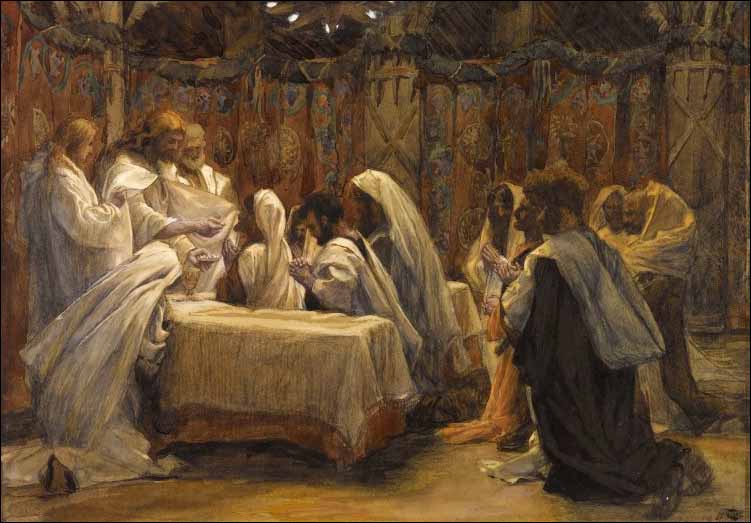
The Apostle Paul describes the Eucharistic meal as a koinonia (1 Cor. 10:16).The Greek word, koinonia, has a great depth of meaning: sharing, partaking, fellowship, communing, and unifying participation in the life of God. When we drink the Blood and eat the Body of our Lord Jesus Christ: we commune with Christ, we share in his resurrection, we partake of his grace, we fellowship with God and his saints, and we are brought into union with his heart and will. In short, we become partakers—people who share in the very life and love of God. Whenever we participate in the Lord’s Supper, we experience Christ’s Eucharistic love.

This God adored by multitudes of angels comes to me as love, the redeeming One, the eucharistic One to give me everything, to fulfill me abundantly. To delight me with himself so that even I, so much immersed in this world, do not want anything else, but only His eucharistic love.

Tadeusz Dajczer, The Mystery of Faith: Meditations on the Eucharist (Brewster, MA: Paraclete Press, 2009), 10.